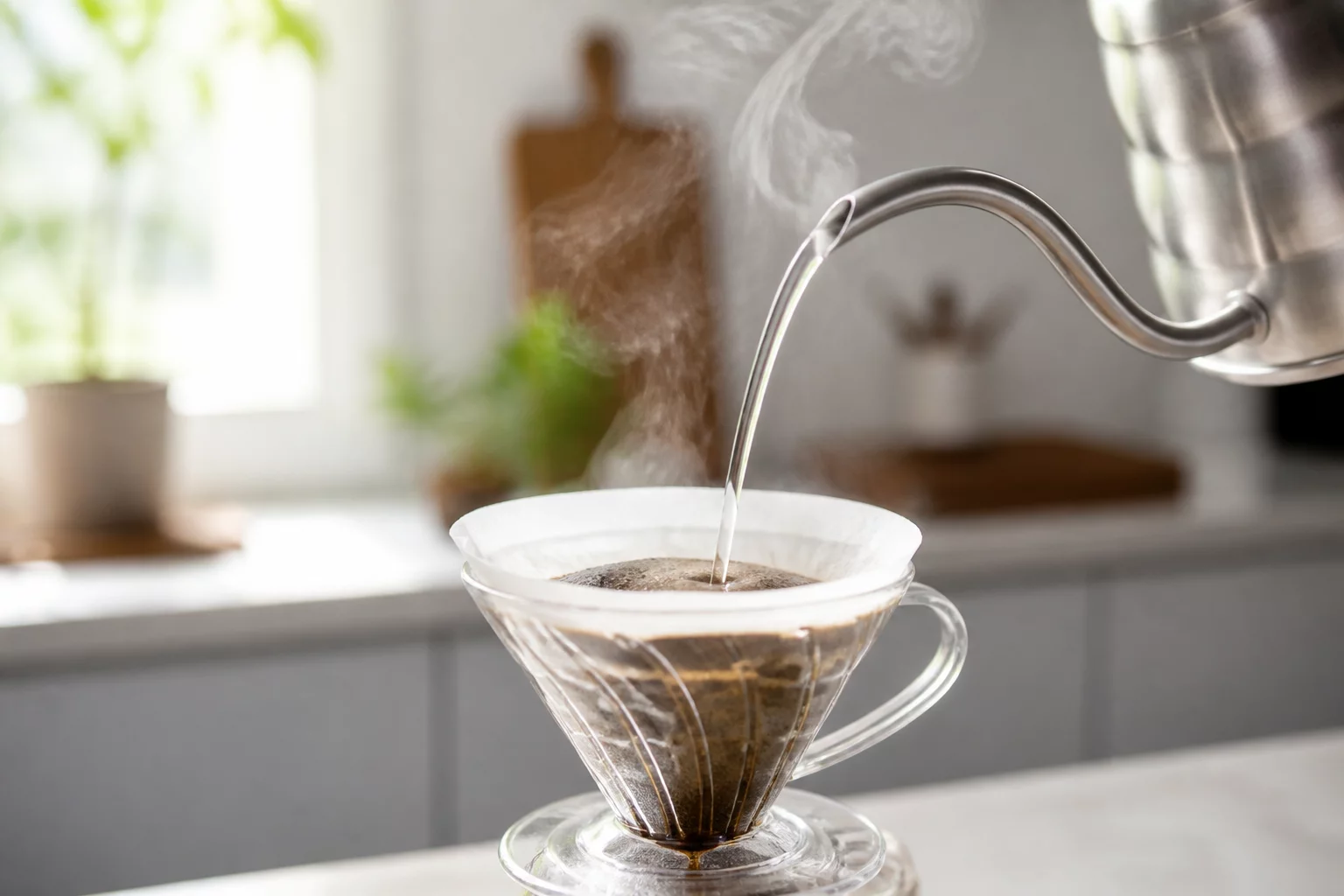
Brewing exceptional pour-over coffee requires meticulous control over how hot water meets ground beans. Standard kitchen kettles produce wide, erratic water surges that disturb the coffee bed unevenly. In contrast, a gooseneck kettle provides a slender, curved spout designed specifically for fluid dynamics and manual brewing accuracy.
1. Unmatched Flow Rate Control
The curved spout restricts water volume naturally. Instead of gushing out all at once, liquid emerges in a narrow, steady vertical stream. This design prevents accidental flooding of the filter basket and lets you dictate exactly how many grams of water pass through per second.
When you pour water slowly in deliberate concentric circles, every coffee particle saturates evenly. Consistent saturation avoids dry pockets and eliminates over-extracted bitter channels where water rushes through path of least resistance.
2. Targeted Water Placement and Turbulence
Manual brewing devices like the V60, Kalita Wave, or Chemex depend on controlled turbulence. Dropping water from too high or in erratic bursts causes micro-fines to migrate to the bottom of the filter, clogging the drain and stalling extraction.
- Gentle bloom phase: Moisten grounds evenly with minimal agitating force during the initial 30 to 45 seconds.
- Controlled spiral patterns: Maintain a gentle, laminar stream from center to edge without washing grounds up the filter wall.
- Flat coffee bed: Finish brewing with a smooth, level bed of spent grounds, confirming uniform percolation.
3. Ergonomic Balance and Wrist Comfort
Standard kettles carry their center of gravity high above the handle, forcing your wrist to fight against tipping forces. Gooseneck kettles position the handle counterbalanced against the base of the spout. This intentional weight distribution allows you to tilt, hold, and rotate the stream smoothly for three consecutive minutes without strain.
4. Thermal Stability and Repeatable Results
High-grade stainless steel construction retains heat throughout multiple pour pulses. You can dial in recipes with repeatable extraction times because temperature loss between pours remains predictable. Paired with a digital scale and a quality manual grinder, the gooseneck kettle completes your foundational pour-over setup.
Barista Pro Tip
Keep the kettle spout approximately 2 to 3 centimetres above the slurry surface. Pouring from close range prevents water drops from gaining unnecessary kinetic energy, preserving the delicate balance of your coffee bed.
Discussion & Insights
0To leave a comment, please log in to your account.
No comments yet. Be the first to start the discussion!